Cities in global and sustainable scientific collaboration network: unveiling cooperation centers
Overview of spatial layout
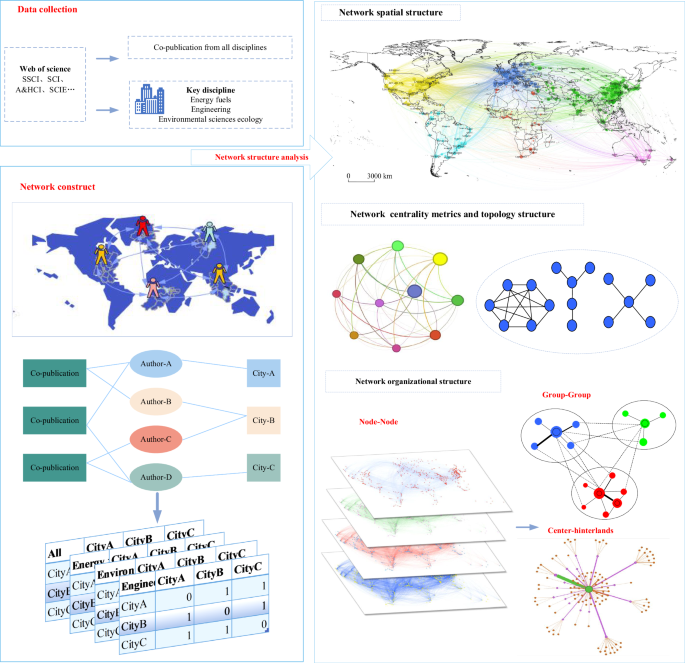
Using a hierarchical clustering algorithm, this analysis divides the GSCN into a four-level hierarchy: core, semi-core, semi-periphery, and periphery, as illustrated in Fig. 2. (1) At the apex is the core layer, exemplified by Beijing, which connects with 93.1% of the cities in this analysis. With the highest number of publication collaborations (261,515), Beijing stands as the central nexus of the GSCN, underscoring its pivotal role in global scientific engagement. (2) The second level comprises cities such as London, New York, Boston, Paris, Shanghai, Guangzhou, and Nanjing. These cities exhibit robust interconnections within the layer and significant engagement across the network, evidenced by high average degree values (514) and average weighted degree values (132,897). Notably, connections within this layer account for 10.74% of their total collaborations, indicating a strong propensity for inter-level engagements. (3) This layer includes 35 cities, such as Hong Kong and Shenzhen, with a relatively high average degree (478) and average weighted degree (63,988). The semi-periphery layer focuses primarily on inter-layer connections, with 29.36% of its connections being intra-layer, highlighting its intermediary role in the GSCN. (4) The fourth level encompasses 535 cities on the fringes of the GSCN. Cities within this layer hold less significance in the network, with both the average node degree and average weighted degree below the overall network metrics. The connectivity within periphery layer cities is relatively low, with a network density of 0.44, slightly below the GSCN’s overall density. However, a significant portion of publication collaborations (67.15%) originates within this layer, emphasizing a strong intra-layer collaboration tendency. Each of these layers plays a distinct role within the GSCN, contributing to the overall structure and function of global scientific collaboration. The core and semi-core layers are crucial for inter-city connections and maintaining the network’s robustness, while the semi-periphery and periphery layers serve as bridges and support the network’s extensive reach. This hierarchical organization illustrates the varying levels of influence and connectivity among cities in the global scientific landscape.

The patterns of GSCN at the city-level.
The number of scientific publication collaborations, both intercontinental and within continents, is visualized in Fig. 3. The specifics are as follows: (1) the proportions of major continents in global scientific collaborations, with Asia, Europe, and North America taking the lead, account for 35.45%, 24.19%, and 18.81%, respectively. (2) Intra-continental collaborations dominate global scientific collaborations, comprising 55.77% of the total. Among these, intra-Asian collaborations are the most numerous, representing 29.36%. Additionally, there are 518,504 collaborations (13.03%) within North America, 389,455 (9.79%) within South America, 85,850 (2.16%) within Europe, 31,991 (0.8%) within Africa, and 24,935 (0.63%) within Oceania. (3) Intercontinental collaborations account for 44.23% of scientific publication collaborations and show significant disparities. Cooperation among Europe, North America, and Asia forms a tight-knit collaboration network. The collaboration between Europe and North America is the most active, accounting for 9.20% of the total global scientific collaborations. Following closely is the collaboration between Europe and Asia, constituting 8.90% of the total. In comparison, cooperation among Oceania, South America, and Africa is relatively weaker. (4) The differences in the proportion of internal and external collaborations are evident for each continent. Asia and South America exhibit a relatively balanced ratio of internal and external collaborations, indicating both close internal cooperation and extensive external connections. In contrast, Europe, Africa, Oceania, and North America tend to engage more in intercontinental collaborations. For instance, Europe has fewer internal collaborations, with the majority originating from other continents. Similarly, Africa heavily relies on external collaborations.

The patterns of GSCN in continents.
Network structural characteristics across disciplines
Centrality metrics
This section analyzes the influence and control of various cities within disciplinary networks by calculating centrality metrics, including degree centrality, weighted degree centrality, and betweenness centrality. These metrics are visualized in accompanying figures to facilitate a comprehensive understanding. Our findings are as follows: (1) Over a quarter of cities worldwide engage in knowledge exchanges with more than 400 other cities, signifying a highly inclusive network that promotes collaboration across cities of diverse sizes. Beijing and London act as central hubs in the global inter-city publication collaboration network, significantly enhancing the network’s connectivity and inclusiveness. As transit nodes, Beijing, London, and Shanghai are crucial in connecting the majority of global cities and play a significant role in the dissemination of knowledge. Weighted degree centrality, reflecting the strength of a city’s connections, with Beijing, London, and New York as the central hubs. Beijing’s exceptional contribution is evidenced by its leading 261,515 publication collaborations, affirming its indispensable role within the GSCN (Fig. 4a). (2) An analysis of centrality indicators reveals a dominance of Asian cities in terms of their centrality within the network. Specifically, 14 out of the top 20 cities, based on degree centrality, are in Asia. This trend is consistent with betweenness centrality, where 15 out of the top 20 cities are Asian. Beijing stands out as a central hub in all analyzed networks, underscoring its critical role in facilitating knowledge exchange and innovation (Fig. 4a). Other notable cities such as Hong Kong, Hangzhou, Sydney, and Seoul serve as critical nodes, acting as significant channels for knowledge flow and innovation, thereby anchoring a vigorous collaboration network predominantly in Asia. (3) The prominence of cities within the network varies substantially across different scientific disciplines. Beijing maintains a consistent position as a central node across various fields, highlighting its versatile role in global scientific collaboration. Other cities, including Shanghai, Nanjing, Wuhan, Guangzhou, Shenzhen, Singapore, and London, display notable standings within networks related to ‘energy fuels’, ‘engineering’, and ‘environmental sciences and ecology’. Their significant positions in these specific disciplines suggest a specialized focus and contribution to global knowledge exchange in these areas (Fig. 4b–d).

a All disciplines, b energy fuels, c engineering, d environmental sciences ecology.
Topological characteristics
Examining the clustering coefficients and average shortest path, the networks of ‘all disciplines’, ‘engineering’, and ‘environmental sciences and ecology’ exhibit notably high clustering coefficients and shorter average path lengths compared to randomly generated networks. These coefficients exceed the clustering coefficient value of 0.502 for random networks, with average path lengths consistently falling below the random network benchmark of 1.8 (Fig. 5a, b). The observed average path lengths reveal the existence of several localized clusters within the network, characterized by dense internal connections and relatively sparse connections between clusters, embodying the quintessential small-world phenomenon. Conversely, the cooperation network in ‘energy fuels’ displays a lower clustering coefficient and a longer average path length, lacking distinct small-world characteristics. This deviation underscores a less integrated and possibly more exploratory or fragmented nature of collaboration within this specific field.

a All disciplines, b energy fuels, c engineering, d environmental sciences ecology.
When analyzing network density and the average degree among nodes, the GSCN of ‘all disciplines’ emerges with the highest network density and average node degree, recorded at 0.5 and 288, respectively (Fig. 5c, d). These figures highlight the network’s extensive linkages of collaborative publications among global cities, indicating strong, robust overall connectivity. By comparison, the networks of ‘engineering’ and ‘environmental sciences and ecology’ exhibit similar network density and average connectivity. In contrast, the cooperation network in ‘energy fuels’ registers a network density and average node degree of 0.12 and 72. This suggests that the collaborative framework in the ‘energy fuels’ area remains underdeveloped, pointing towards an imperative for enhanced cooperative engagement.
Spatial organization structure across disciplines
Community structure analysis
With the application WSBM, this section dissects the GSCN into distinct communities, unveiling patterns of both strong and weak connections among cities. This approach enabled the identification of optimal groupings (K = 3–8) based on maximum likelihood connectivity, facilitating a nuanced understanding of the network’s community structure across various disciplines, including ‘all disciplines’, ‘energy fuels’, ‘engineering’, and ‘environmental sciences and ecology’, as depicted in Fig. 6.

a.1 Communities of all disciplines, a.2 communities of energy fuels, a.3 communities of engineering, a.4 communities of environmental sciences and ecology. b.1 distributions of all disciplines, b.2 distributions of energy fuels, b.3 distributions of engineering, b.4 distributions of environmental sciences and ecology.
Firstly, the community structure division of the GSCN, encompassing all disciplines, exhibits clear core-periphery characteristics across groups. Figure 6(a.1) reveals that the GSCN is partitioned into four groups, where Group 1 and Group 2 are characterized by higher density of knowledge collaborations and substantial inter-group connections. Specifically, Group 1 is identified as the core, and Group 2 as the semi-periphery, as depicted in Fig. 6(b.1). In contrast, Group 3 and Group 4 exhibit less frequent inter-group collaborations and are thus categorized as the periphery. The spatial distribution of nodes within these groups, as shown in Fig. 6(b.1), indicates that the core and semi-periphery groups boast a global presence, whereas the periphery groups are more regionally concentrated. The extensive knowledge collaborations within and between Groups 1 and 2, distributed across continents, suggest that leading innovation hubs worldwide are actively engaged in global knowledge collaborations, enriching the network with diverse knowledge inputs. In contrast, Groups 3 and 4, the periphery, have fewer knowledge links both internally and externally, with a concentration of nodes in Asia and Africa. This indicates Asia’s evolving stature as a pivotal knowledge center globally, although with some cities are yet to achieve a comprehensive level of knowledge globalization.
Secondly, this analysis examines the community structures within specific disciplines, indicating that ‘energy fuels’ and ‘engineering’ exhibit a core-periphery arrangement, whereas the GSCN in ‘environmental sciences and ecology’ presents a dual-core structure. Figure 6(a.2) and (a.3) show that ‘energy fuels’ and ‘engineering’ have a dominant core group (Group 1) with extensive knowledge collaborations. The remaining groups, with fewer internal connections, are identified as peripheral groups. In the ‘energy fuels’ network, the peripheral Group 2 maintains a closer association with the core Group 1 than do other peripheral groups. The ‘environmental sciences and ecology’ network features a dual-core configuration, as visualized in Fig. 6(a.4), with two core groups (Groups 1 and 2) engaging in significant knowledge collaborations. Groups 3 and 4, despite fewer internal collaborations, maintain more extensive links with the core groups and are thus identified as semi-peripheral groups.
Additionally, Fig. 6(b.2) and (b.3) show the distribution of nodes in different disciplinary networks. It was found that the core group cities in ‘energy fuels’ and ‘engineering’ disciplines are scattered all over the world, with cities from different countries actively participating in GSCN. However, the peripheral group nodes in ‘energy fuels’ and ‘engineering’ networks comprise 71 and 480 nodes, respectively, suggesting a substantial number of nodes in the ‘engineering’ network are peripherally integrated, indicating a lesser degree of inclusion. Specifically, the community structure in the ‘environmental sciences and ecology’ network exhibits pronounced regional characteristics. As depicted in Fig. 6(b.4), the core groups (Groups 1 and 2) in the ‘environmental sciences and ecology’ network are geographically split between the eastern and western hemispheres, with Asia representing the east and Europe and the Americas representing the west. The semi-periphery groups (Groups 3 and 4) also display an east-west division, with Asia and Africa in the east and the Americas in the west, illustrating the geographical and thematic dichotomies within GSCN.
Center hinterland structure analysis
Utilizing dominant flow analysis, this analysis unveils the intricate ‘center-hinterland’ structure within the GSCN. As shown in Fig. 7, the size of the nodes represents their strength, while the thickness of the lines indicates the quantity of publication collaborations. The GSCN manifests as a composite of multiple ‘center-hinterland’ systems, each varying in size and collectively forming a discontinuous ‘archipelago’ structure. The largest one is the ‘Asian archipelago’, with Beijing as its core, spanning 139 cities, predominantly located in East Asia. This archipelago represents the largest of the configurations, underscoring the significant role of Beijing and its surrounding cities in regional and global scientific collaboration. Following closely is the ‘Africa–European archipelago’, centered around pivotal cities such as London and Paris. African cities (47.9%) and European cities (33.3%) jointly form 81.2% of this 73-city archipelago. This arrangement highlights the influential position of European cities within Euro-African publication collaborations, a dynamic interwoven with historical colonial ties. The third noteworthy archipelago, the ‘North American Archipelago’, is centered on New York and encompasses 56 cities, with North American cities accounting for 75% of the total. The three archipelagos, anchored by core cities in Asia, North America, and Europe, play critical roles in shaping the GSCN structure, demonstrating the global influence of cities both within and beyond their respective continents.

a ‘All disciplines’, b ‘energy fuels’, c ‘engineering’, and d ‘environmental sciences ecology’.
Distinct variations in the center-hinterland structure are observed across different scientific disciplines. In the networks of ‘energy fuels’ and ‘engineering’, Chinese cities, prominently led by Beijing, constitute the largest center-hinterland cluster. This cluster includes significant hinterland cities such as Shanghai, Nanjing, and Shenzhen, illustrating the dominant role of Chinese cities in these disciplines. Other smaller yet notable clusters revolve around cities like Delhi, Chennai, Sao Paulo, and Moscow. In these disciplines, the clusters anchored by London and New York are comparatively limited in scope. In contrast, within the ‘environmental sciences and ecology’ network, the Beijing-centric cluster contracts, while the influence and reach of clusters centered on New York and London notably increase. The broadest clusters span East Asia, Europe, and North America, emphasizing the pivotal contributions of cities from these regions in forming the GSCN structure.
link