How EVs and AI are changing training paths for next-gen autoworkers


How do AI and electric vehicles shape jobs in the auto industry
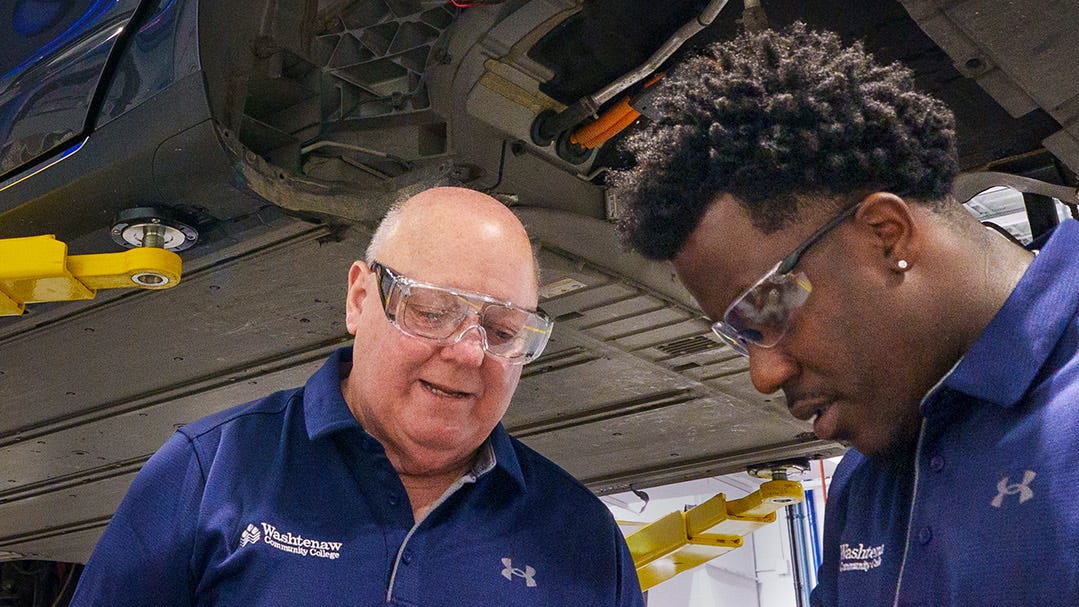
Students at Washtenaw Community College’s Advanced Transportation Center shared their thoughts about the future of work in the automotive industry.
- Artificial intelligence is already accelerating the loss of entry-level positions at automakers ― and the industry is looking to recalibrate what it takes to earn a lasting career in carmaking.
- Experts say the future auto employee needs to know how to use AI to help U.S. brands keep up with Chinese.
- Coursework at Washtenaw Community College’s Advanced Transportation Center includes how to design and repair electric vehicles, deploy artificial intelligence and manufacture semiconductors.
Lindsey Maurer, a first-year student at Washtenaw Community College’s Advanced Transportation Center, is learning the latest skills required to work in the ever-evolving automotive industry.
Her coursework includes how to design and repair electric vehicles, deploy artificial intelligence and manufacture semiconductors ― the very skills the industry has said technicians need to master to build and maintain the vehicles of the future.
But Maurer is worried that it won’t be enough. And even at community college, the cost to pursue the industry is enormous. And the skills you invest in may not have a long shelf life.
“The most intimidating thing about the industry is the tools, the sheer cost of them. Everything can cost thousands of dollars just for one tool. But without the right tools, you cannot do anything the right way,” she said. “It’s uncertain, that’s my issue. Even if you get the right job and you get secured that way, you can be laid off, or something can happen where you’re just stuck.”
As automobiles transition from machines to devices, the most valuable skills in an automotive professional’s toolkit have necessarily changed.
Artificial intelligence is already accelerating the loss of entry-level positions at automakers ― and the industry is looking to recalibrate what it takes to earn a lasting career in carmaking.
Basic skills asked of employees in entry-level positions may be bypassed in favor of more advanced knowledge. One example of change: Fewer automaker jobs require writing software in workplaces where the software is writing itself.
General Motors said it uses artificial intelligence across its manufacturing process, from the inception of a vehicle’s design to the lines where it is assembled. More than 15% of the software code GM develops now comes from AI-assisted tools, the company said. GM said AI has helped catch 10 times more software bugs far earlier in the vehicle development cycle from previous pre-production software assessments.
AI tools in recent years have been transformative for GM’s workforce, according to the company. GM has hired several executives of late from companies proficient in emerging software technology. In March, the automaker hired its first-ever AI officer, and in June, it poached Sterling Anderson, the former Tesla and Aurora leader, for the role of executive vice president, global product and chief product officer.
GM’s approach to AI isn’t cautious, but commonsense, said David Richardson, GM’s senior vice president of software and service engineering.
Hype isn’t enough of a reason to pursue AI, Richardson said, nor is it to deploy it unless there’s proven cost or time advantages, he said.
“One of the things I tell developers here — because there’s a lot of fear about the future of jobs and AI — that the best thing you can do is play with these tools, because I think you’ll very quickly learn where it’s not magic, where it provides value and where it doesn’t,” Richardson said. “In the future, the people who will have the jobs are the ones that will know how to use AI in their work.”
Skills needed to face industry change
GM does not disclose hiring figures by level, so the change to entry-level positions GM has historically hired on an annual basis can’t be determined outside the company. Spokeswoman Maria Violette said that GM views AI as a tool to enhance jobs, not replace them.
“We’re focused on how AI can make our people safer, more efficient, and more creative,” she said. “For example, in manufacturing, AI helps reduce downtime and handle ergonomically difficult or repetitive tasks, so employees can focus on craftsmanship, quality, and innovation. In engineering, AI accelerates design cycles and improves simulation accuracy, allowing teams to test and validate ideas faster than ever.”
Still, all that change begets more change. In recent years, products typical in the tech world like batteries and computer chips have flooded the automotive space.
Those changes alone would be enough to meaningfully alter what skill sets automakers hire for and invest in continuous training even without increased competition from foreign companies, according to Bernard Swiecki, vice president, mobility and research at the Detroit Regional Partnership.
“Right now, we have mostly been sheltered in this country from the advances that the Chinese automotive industry has made in terms of productivity, cost reduction and so on,” Swiecki said. “But it’s really only a matter of time before we do have to compete with the Chinese.”
It also opens the door for employees to transfer into the auto industry with relevant experience, increasing competition while overall employment figures may decrease. While automakers struggle to solve software issues that have led to large, expensive recalls, finding workers with programming and coding experience becomes even more necessary, Swiecki added.
For education to be the most future-proof, colleges and trade schools serve as the proving ground for automotive employees in its latest technology-driven era.
As the auto industry evolves, experts say Michigan schools in particular need to change the way automotive students are taught the skills needed to compete. Companies like Toyota have partnered with schools like Washtenaw Community College to help craft programs of study most applicable to the jobs it plans to offer.
In 2014, WCC launched its Advanced Transportation Center that expands its automotive curricula to include skills vital to information technology and advanced manufacturing to prepare students for next-generation mobility careers. At any given time, more than 1,000 students are enrolled in over 60 courses in automotive and cybersecurity technologies alone, according to the college.
WCC opened an electric vehicle lab on Oct. 13 after securing $2.5 million in congressional grants.
U.S. Rep. Debbie Dingell, D-Ann Arbor, addressed attendees about how critical it is to educate technicians on emerging technologies, even if those vehicles aren’t widely available on U.S. roads today.
When speaking to automotive leaders, “the biggest concern they have in this country is a trained workforce. I’m determined to keep our domestic auto industry at the forefront of innovation and technology, and we have to be building all the technology,” Dingell said. “The global marketplace wants those EVs, and if we don’t build them here in America, we are not going to be a leader, and we have to have people that are going to be able to service them.”
Dr. Brandon Tucker, executive vice president for instruction at WCC, has no qualms about directly asking automakers like Ford Motor Co. and Toyota North America how to adapt instruction to meet their workforce needs.
“We have to have industry connected to education giving us not just what’s happening now, but where are they going over the next three to five years so we can ensure our programs are keeping pace,” Tucker told the Detroit Free Press. “What we did in 2014, and what we’re doing 11 years later, the framework is the same but the tools that we teach are changing. That’s how we’ve been able to keep up.”
More car tech
Software-defined vehicles — those in which software controls the core functions of a car rather than hardware — requires a transformational overhaul in the automotive workforce, said Jeff Makarewicz, group vice president of advanced research and technical resources at Toyota Motor North America.
“The jobs aren’t being replaced, but they’re evolving. New skill sets are required. If you’re going to have more automated equipment, you’re going to need somebody to manage the automation and to program that equipment,” Makarewicz said. “Today’s vehicles have lidar, radar and sensors — these are new skill sets that we’re going to have to train the next generation of technicians to manage and maintain and replace.”
Ford Motor Co. recently convened a summit called Ford Pro Accelerate: The Essential Economy at the renovated Michigan Central Station where CEO Jim Farley called on federal, state and local government and community leaders to provide more vocational training and encouragement to recruit people into the skilled trades profession.
Will AI snap up autos jobs?
Swiecki recommends that prospective automotive employees familiarize themselves with emerging technologies as soon as possible, gaining real-life experience as dealership technicians to better understand finished products.
Electric vehicles already feature advanced technologies that require a different process to maintain. Maurer said at the WCC program she learned initiating service mode through the vehicle’s computer is required to work on it, “Otherwise you will destroy the vehicle.”
Even as technology advancements change job requirements, automakers aren’t quite ready to eliminate entire internal departments just yet.
According to Richardson, GM leverages AI to reduce “tedious” low-level coding tasks, not turning over vital controls to a sentient supercomputer. Movie lovers may recall Richardson’s example from Stanley Kubrick’s “2001: A Space Odyssey.”
“It’s not like in a sci-fi movie where HAL is going off and making decisions,” Richardson said. “It’s really like an expert tool for us to get better insights, faster. There might be some initial resistance, but then I think people see the value. The value isn’t, ‘Oh, it’s doing my work,’ it’s, ‘I don’t have to worry about some of that stuff that was manual toil.’ ”
Still, the technology is far from perfect, and going all in on AI would be premature, Richardson said. Generative AI mistakes, called “hallucinations,” can occur just as quickly as the system writes code, and more onus is on the human to catch those mistakes, Richardson said.
“There is a sweet spot. If you trust the AI too much now, you might actually be getting code 90% right but 10% is actually buggy,” he said. “It is much easier to check that it’s correct than to generate it yourself, but we still have the human in the loop. You can’t blindly trust them.”
To address that, GM said it ensures work is done in “chunks” rather than all at once to give human programmers time to identify errors before moving on to the next challenge.
GM is introducing advanced AI to its advanced driver assist system SuperCruise, that dramatically increases its scope and capability, according to GM’s former Tesla exec Anderson.
“We’re training with millions of miles worth of real-world data, millions of high-fidelity simulations, and targeted closed-course validation. Our fleet is driving across America, collecting data daily, feeding our AI foundation model with diverse real-world events,” Anderson said in an op-ed published Oct. 15 in Fortune.
He also described a vehicle capable of learning the needs of its driver that may one day even act as a personal assistant: “The bottom line: Your car will be capable of doing more for you tomorrow than it does today.”
Developing software skill sets in the technologies key to emerging automotive technologies — over the air updates, software-defined vehicle, cybersecurity, is a major way the Detroit region can diversify its talent pool while hedging its bets for whatever pace of change the industry may undergo, Swiecki said.
“People say, ‘You’ll lose your job to AI,’ but as a counter to that, people say, ‘You might lose your job to someone who knows how to use AI,’ ” Swiecki said. “If that’s the case, be the person who knows how to use AI. Building that skill set makes you deployable across different industries.”
Jackie Charniga covers General Motors for the Free Press. Reach her at [email protected].
link