A Career Built on Collaboration, Curiosity, and Patient-Centered Research
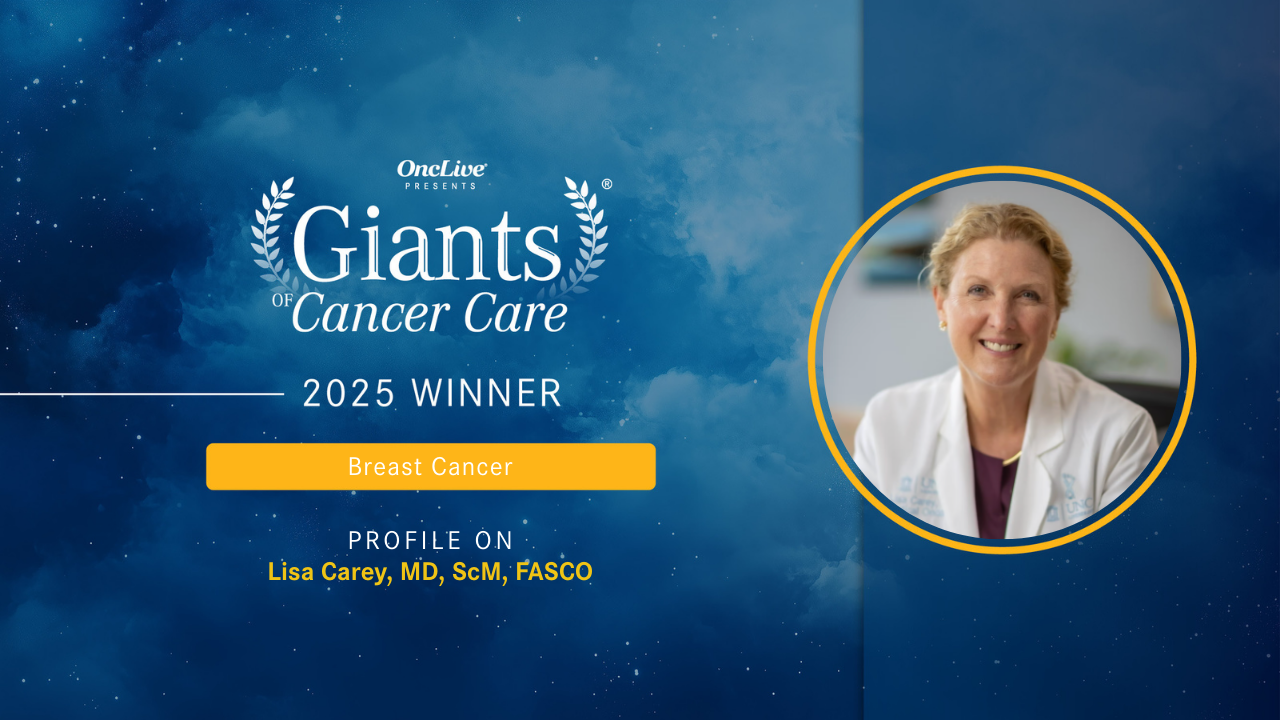
Lisa M. Carey, MD, SCM, FASCO, has never been afraid to go where the hardest clinical questions lead. From spearheading trials illuminating racial disparities in triple-negative breast cancer (TNBC) and evaluating dual vs single-agent HER2 inhibition, to leading efforts that will expand rural access to clinical trials and power clinical trials leveraging adaptive artificial intelligence (AI) modeling, her career is tied together by one principle: scientific progress must remain grounded in clinical reality and serve the diverse patients seen every day in clinic.
“I’ve always come at this from the standpoint of the kind of problems I’m running into when I see patients,” Carey said. “There’s a reason I’ve worked across so many breast cancer subtypes; the questions come from the clinic, and it’s our job to design trials that answer them.”
Carey, who was named a 2025 Giant of Cancer Care in Breast Cancer, is renowned for translating biological insights into better treatments for patients, always involving an ever-growing group of collaborators.
“I’ve had the good fortune of working with Dr Carey for approximately a decade,” said Ann H. Partridge, MD, MPH, the 2023 inductee in the breast cancer category, interim chair of the Department of Medical Oncology at Dana-Farber Cancer Institute in Boston, Massachusetts, and cochair of the National Cancer Institute’s (NCI) Alliance for Clinical Trials in Oncology Breast Committee with Carey. “Lisa, first and foremost, is a leader who keeps the mission in mind. She takes great care of her colleagues, as well as her patients, in an extraordinary way. Whether it’s designing a trial or running a large national meeting, Lisa always does it with an eye toward excellence, as well as with empathy, support, and a touch of humor.”
Carey serves as the L. Richardson and Marilyn Jacobs Preyer Distinguished Professor for Breast Cancer Research at the University of North Carolina (UNC) School of Medicine, deputy director of clinical sciences at the Lineberger Comprehensive Cancer Center, co-principal investigator of the NCI Specialized Program of Research Excellence (SPORE) Award to UNC, and the Chief Clinical Research Officer for UNC Health. She also serves in major national leadership positions, including as a member of the NCI Breast Cancer Steering Committee and cochair of the Translational Breast Cancer Research Consortium (TBCRC) Steering Committee.
A Research-Focused Path To Oncology
After obtaining her undergraduate degrees in biology and art history at Wellesley College, Carey went on to receive her medical degree from Johns Hopkins University School of Medicine. She stayed at Johns Hopkins Hospital for her residency in internal medicine and fellowship in medical oncology and obtained an advanced degree in clinical investigations.
“I came to the breast cancer field differently,” she explained. “I knew early in medical school that I wanted to be a researcher, but oncology was where you could see discovery translated very quickly into care. If you’re a young researcher, that’s where you want to be.”
A formative moment when Carey was a junior resident solidified her choice. During the Christmas season, Carey had been assigned to the cancer wards at The Sidney Kimmel Comprehensive Cancer Center at Johns Hopkins. “You’d think it would be bleak, as many of these patients were facing their last Christmas,” she recalled. “But they were joyful, inspiring. I thought, ‘These are people I want to hang out with. This is where I belong.’ ”
Carey’s decision to specialize in breast cancer was largely influenced by its collaborative culture. “Breast cancer was the most collaborative of any group I encountered,” Carey said. “Researchers and clinicians trusted each other, shared data, worked as a community. There was a real desire to learn from each other. That was incredibly appealing.”
Building UNC’s Clinical Trial Powerhouse, One Trial At A Time
When Carey joined the faculty at UNC and the Lineberger Comprehensive Cancer Center in 1998, the institution was renowned for its laboratory and epidemiologic science but lacked a strong clinical research infrastructure in breast cancer. “For a brief time, I was the only breast cancer doctor here,” she noted. “UNC needed to build that clinical presence.”
Enter Carey, who successfully helped build a world- class clinical trials program and has since led multiple influential studies. Early in her tenure, Carey partnered with molecular biologist Charles M. Perou, PhD, and the late, great epidemiologist Robert C. Millikan, PhD, leader of the Carolina Breast Cancer Study, a seminal epidemiological study in breast cancer that was intentionally designed to overrepresent Black and premenopausal patients, groups that were typically underrepresented in population-based studies. Findings shared in their subsequent JAMA publication
in 2006 revealed that young and Black women are disproportionately affected by basal-like TNBC.1
“That paper was the first time anybody said, ‘Yes, receptor status is important, but it’s even bigger than that,’ ” she said, noting that, “That finding was possible only because the Carolina Breast Cancer Study was designed from the start to be diverse.”
This discovery catalyzed much of Carey’s subsequent research in TNBC. She led the first trial ever endorsed by the TBCRC: the randomized, phase 2 TBCRC 001 study (NCT00232505).2 Data published in the Journal of Clinical Oncology in 2012 showed that, despite strong preclinical data, cetuximab (Erbitux) plus carboplatin produced responses in fewer than 20% of patients with metastatic TNBC. Although EGFR pathway analysis showed that most tumors had EGFR activation, cetuximab blocked EGFR pathway expression in only a minority of patients, and that tumors either had or developed alternate mechanisms for pathway activation. This study changed understanding of the EGFR pathway’s role in, and the biological heterogeneity of, TNBC.
Through TBCRC, Carey and her colleagues helped create a national platform for investigator-initiated collaborative trials across academic centers, enlisting nearly 8000 patients in studies since its inception. “The TBCRC is something we are enormously proud of,” Carey said. “It has been a long- term [investment in] collaboration; a place where junior investigators can cut their teeth on trials and where truly practice-changing ideas originate.”
Carey’s collaborative philosophy and innate curiosity also extend into the HER2-positive setting. She developed and led the pivotal phase 3 CALGB 40601 study (NCT00770809) of neoadjuvant dual HER2 blockade with trastuzumab (Herceptin) plus paclitaxel with or without lapatinib (Tykerb).3 True to form, she insisted on mandatory research biopsies and simultaneous reporting of clinical and translational end points.
“It turns out the key part of the results was not [whether the] drugs [were administered as] combinations vs single agents. What was at least as important, if not more so, was what kind of cancer the patient had at a molecular level and whether there was evidence of immune activation. That was a massively important finding, because everybody treats these cancers as if they’re all the same, and they’re not. We can be much more thoughtful about it.”
Findings from CALGB 40601 helped spur the later development of HER2DX, the first genomic assay for HER2-positive breast cancer, and validated the importance of immune activation in breast cancer.4
Mentorship, Community and The Power of Leadership
Carey credits her success in large part to her mentors and collaborators, including Nancy E. Davidson, MD, of Fred Hutchinson Cancer Center in Seattle, Washington; Eric P. Winer, MD, of Yale School of Medicine in New Haven, Connecticut; Clifford A. Hudis, MD, of Memorial Sloan Kettering Cancer Center in New York, New York; and Antonio C. Wolff, MD, of Johns Hopkins School of Medicine in Baltimore, Maryland. Davidson in particular influenced Carey’s career trajectory and emphasized the importance of balancing personal life and professional goals, something Carey now tries to impart to others.
“I’ve had several mentors; I think that’s how you grow best,” she said. “Mentorship isn’t just about research,” Carey said. “It’s about thinking through how you want your whole life to look.”
Her partnership with Partridge is also one of the most personally and professionally rewarding. “One of the great pleasures of my career has been my relationship with Ann Partridge. We were chosen to cochair the Alliance for Clinical Trials in Oncology Breast Committee [in 2016],” Carey reflected. “People are proud of the direction we’ve taken it in, how we’ve run it, and the kind of trials that we’re developing. And I gained a close friend in the process.”
“On a personal standpoint, [Lisa] has become a good friend and close colleague,” Partridge added. “I rely on her and her judgement in a lot of ways, [including her] experience in breast cancer care, leadership on the world stage, managing a busy practice, and [balancing her] busy family over the years. She’s offered me great personal advice over our years of friendship.”
Carey also emphasized the role of professional societies in her own leadership development, noting that early encouragement and sponsorship from mentors like Winer helped her gain a seat at the table within these organizations. She has since served in several roles for the American Association for Cancer Research and the NCI and was elected to the American Society of Clinical Oncology (ASCO) Board of Directors from 2020 to 2024. As a board member, she often functioned as a liaison between ASCO and the European Society for Medical Oncology for their clinical research initiatives.
“ASCO is probably the most important professional organization that we have internationally. You [have so many] leadership [opportunities] in breast cancer care and cancer care through ASCO, because it’s so hugely involved in education and research and training,” she said.
Next Frontier: Expanding Clinical Trial Accessibility and AI-Driven Adaptive Trials
Working at UNC, a public institution serving a diverse population across urban and rural settings, is at the epicenter of Carey’s dedication to promoting equity in cancer research.
“We take care of patients from all over the state of North Carolina,” she noted. “That includes patients with deep-seated needs for a variety of reasons. Our patients come from all walks of life, rural, socioeconomic, racial and ethnic groups. That informs our interest in disparities work. North Carolina has the second-largest rural population in the country, so we must learn how to make things much more accessible.”
In July 2025, Carey assumed a new role as chief clinical research officer of UNC Clinical Research Partners, where she aims to facilitate clinical trial access across the UNC Health network, including rural hospitals.5 “We want to maximize clinical research across all fields of medicine and bring innovative treatments to patients where they are,” she said.
Carey’s plans revolve around tackling new research questions through collaboration and innovation. Lineberger Comprehensive Cancer Center was recently awarded a $28 million Advanced Research Projects Agency for Health–funded grant for its role as the lead institution in a TBCRC clinical trial and developing adaptive trials for metastatic breast cancer. Carey and colleagues are using this grant to conduct a new clinical trial using adaptive AI and machine learning to create models of clinical characteristics that better predict treatment sensitivity and resistance.6
“We haven’t [yet brought] a synthesized, multimodal model into the clinic,” she said. “Now we’re going to do that right, which will hopefully help our patients [in real time].”
Fifteen TBCRC institutions are participating in the project, which includes dedicated statistical and translational working groups, Carey explained, adding that she is galvanized by the potential to integrate complex biomarker modeling, blood-based assays, and clinical data into a seamless learning system.
A Life of Adventure: What Drives Carey Outside of The Clinic?
When not in the clinic or meetings, Carey can be found scuba diving, skiing, playing pickleball, or riding her bike to and from work. From safaris across the Serengeti to excursions squeezed in between oncology meetings, Carey is also a lover of travel. Her next big trip is to Vancouver with friends, followed by a hiking trip to Patagonia at Christmastime and a trip down the Nile the following spring.
“I like going off the beaten trail,” she said. “And I’m outdoorsy; I live on a lake, and sitting by the water at the end of a busy day is my Zen.”
As a vestige of her East Coast upbringing, Carey is also in possession of a very particular set of skills. “I know how to shuck oysters and clams,” she laughed. “Now I make all our fellows learn. I think it’s a useful life skill.”
Despite an intense professional life, Carey’s husband of 34 years, Matthew Ewend, MD—a medical school classmate, former chair of the Department of Neurosurgery at UNC, and current chief clinical officer at UNC Health—and their 3 adult children remain at the center of all she does.
Reflecting on her career journey, Carey said, “If my younger self could see me now, she’d be proud that the research I do is rigorous and clinically meaningful.”
Ultimately, Carey’s legacy is not just defined by her myriad leadership positions and robust body of research, but by her unwavering conviction that cancer research is a team effort.
“An overarching theme with Lisa is that she goes the extra distance for her patients, her colleagues, and her friends,” Partridge said. “When there’s no right answer, she’s going to get a number of opinions from people she trusts to do the right thing by her patient and inform their care.”
“You can call it collaboration,” Carey reflected, “but at the end of the day, I’m not a specialist; I just go where the questions are, with the experts who can help answer them.”
References
- Carey LA, Perou CM, Livasy CA, et al. Race, breast cancer subtypes, and survival in the Carolina Breast Cancer Study. JAMA. 2006;295(21):2492-2502. doi:10.1001/ jama.295.21.2492
- Carey LA, Rugo HS, Marcom PK, et al. TBCRC 001: randomized phase II study of cetuximab in combination with carboplatin
in stage IV triple-negative breast cancer. J Clin Oncol. 2012;30(21):2615-2623. doi:10.1200/JCO.2010.34.5579 - Carey LA, Berry DA, Cirrincione CT, et al. Molecular heterogeneity and response to neoadjuvant human epidermal growth factor receptor 2 targeting in CALGB 40601, a randomized phase III trial of paclitaxel plus trastuzumab with or without lapatinib. J Clin Oncol. 2016;34(6):542-549. doi:10.1200/JCO.2015.62.1268
- HER2DX. Reveal Genomics. Accessed August 4, 2025. https:// www.reveal-genomics.com/her2dx
- Carey to lead UNC clinical research partners. News release. UNC School of Medicine. June 6, 2025. Accessed August 4, 2025. lead-unc-clinical-research-partners/
- UNC Lineberger awarded up to $28M to develop an adaptive clinical trial for metastatic breast cancer. News release. UNC School of Medicine. June 17, 2025. Accessed August 4, 2025. to-28m-to-develop-an-adaptive-clinical-trial-for-metastatic- breast-cancer/
link