An fsQCA approach to identifying pathways for digital-professional integration in engineering education
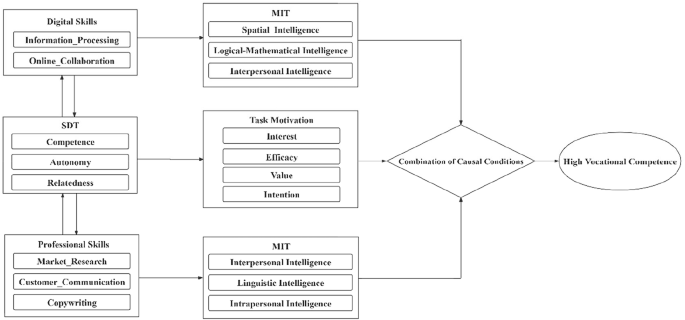
Reliability and validity
To evaluate the reliability and validity of the measurement instrument, we assessed factor loadings, Cronbach’s alpha, composite reliability (CR), and average variance extracted (AVE) for each construct. Table 1 reports the results related to convergent and discriminant validity, as well as internal consistency. All Cronbach’s alpha values ranged from 0.882 to 0.931, and all CR values exceeded the recommended threshold of 0.70, indicating strong internal consistency and construct reliability (Fornell and Larcker, 1981). Furthermore, AVE values for all constructs were above 0.50, providing evidence of satisfactory convergent validity (Segars, 1997). Inter-construct correlations ranged from 0.463 to 0.657, all of which were lower than the square root of the corresponding AVE values, thereby confirming discriminant validity (Chin, 1998).
In addition, model fit indices from structural equation modeling supported a good overall model fit: χ²/df = 3.157 ( < 5), RMSEA = 0.039 ( < 0.05), CFI = 0.937 ( > 0.90), TLI = 0.946 ( > 0.90), and SRMR = 0.038 ( < 0.05). Collectively, these results demonstrate that the measurement model possesses strong psychometric properties, with robust reliability, convergent validity, and discriminant validity.
Descriptive statistics and difference analysis
Our study assessed the changes in students’ professional skills, digital skills, and task motivation before and after the digital skills training (e.g., Fig. 2). To quantify the training effect, we first conducted descriptive statistics and difference analysis on all the measured dimensions. Table 2 presents a comparison of the pre-test and post-test scores for various professional skills (e.g., market research, customer communication, copywriting), digital skills (e.g., information processing and online collaboration), and task motivation dimensions (interest, efficacy, value, and intention). After the digital training, the means for all dimensions significantly increased. For example, the average score for market research increased from M = 85.81 (SD = 6.30) to M = 89.14 (SD = 4.78), and information processing rose from M = 86.17 (SD = 4.35) to M = 92.81 (SD = 3.09). Paired-sample t-tests indicated that these changes were statistically significant (p < 0.001).

Mean scores across constructs (pre and post).
To further evaluate the training effect, we also calculated Cohen’s d effect size to measure the magnitude of change for each dimension. The effect sizes were interpreted as follows: 0.2 represents a small effect, 0.5 a medium effect, and 0.8 or above a large effect. The results (as shown in Table 3) revealed that the effect sizes for most dimensions were above 1.0. For instance, the effect sizes for copywriting (d = 1.73), information processing (d = 1.76), and vocational competence (d = 2.10) were all large, suggesting that the digital skills training had a significant overall impact on students’ skills and motivation.
We calculated skewness and kurtosis. The Q-Q plot (shown in Fig. 3) indicates that the overall distribution of data before and after training closely approximates a normal distribution. The gray area marks the ±1.5 reasonable deviation ranges from the theoretical reference line, with data points lying within this range, indicating that our data distribution characteristics meet expectations. After training, the fit of the data distribution with the theoretical normal distribution improved, and the deviations in skewness and kurtosis significantly decreased, further optimizing distribution.

Q–Q plots of skewness and kurtosis (pre and post).
Fuzzy-set qualitative comparative analysis
The primary objective of our study was to identify the key skill combinations that contribute to the improvement of students’ vocational competence through fuzzy set qualitative comparative analysis (fsQCA). This analysis process involves three steps: fuzzy set calibration, necessity analysis, and sufficiency analysis, to reveal which combinations of skills in the integration of digital and professional skills (Digital-Professional Integration) contribute to significant improvements in students’ vocational competence.
Calibration of fuzzy sets
We performed three-level fuzzy set coding on the improvements in professional skills, digital skills, and task motivation, which clearly reflects the high, medium, and low levels of ability improvement for the participants. Specifically, the data were divided into three coding intervals: High (above the 67th percentile, coded as 1, indicating full membership in the fuzzy set), Mid (above the 33rd percentile but below the 67th percentile, coded as 0.5, indicating partial membership in the fuzzy set), and Low (below the 33rd percentile, coded as 0, indicating non-membership in the fuzzy set). These percentile thresholds were chosen based on the data distribution to better capture the different levels of skill improvement. After calibration, we generated a fuzzy set dataset containing the indicators of task motivation, professional skills, and digital skills, laying the foundation for subsequent necessity and sufficiency analyses.
Analysis of necessary conditions
At this stage, we conducted necessity analysis on the professional skills, digital skills, and task motivation to investigate whether these factors are necessary conditions for improving vocational competence. Both positive and negative conditions were included in the analysis to comprehensively assess the potential impact of each variable on vocational competence. According to the criteria of Fiss (2011) and Schneider and Wagemann (2010), consistency values exceeding 0.9 are considered necessary conditions. As shown in Table 4, the consistency and coverage result for both the positive and negative conditions did not exceed 0.9, indicating that no single condition can independently serve as a necessary condition for vocational competence.
Based on Ragin’s (2009) explanation, coverage is used to measure the extent to which a condition or combination of conditions explains the outcome. Typically, a coverage value exceeding 0.5 indicates that the condition has some explanatory power for the outcome. As shown in Fig. 4, the coverage for the positive conditions was all above 0.5, reflecting a broad explanatory range for these conditions in the outcome variable. In contrast, the coverage for the negative conditions was generally lower, indicating limited contribution to explaining vocational competence. Combining the results of consistency and coverage, we conclude that although the positive conditions show some explanatory power in terms of coverage, they did not meet the consistency threshold for necessity. This further suggests that these conditions may be more important in sufficiency analysis rather than in necessity analysis. Therefore, students’ vocational competence is influenced by the interplay of multiple factors, rather than by the independent effect of a single variable.

Consistency and coverage analysis of necessary conditions.
Configurational analysis of sufficient conditions
Following the necessity analysis, a truth table was constructed to represent all theoretically possible configurations of the nine causal conditions included in the study. Given that the number of possible combinations is calculated as 3⁹ (since each condition was calibrated into three fuzzy-set levels: high, medium, and low), the resulting truth table contained 19,683 rows, each representing a unique configuration. The initial truth table was then refined by applying filtering criteria. Based on the recommendation by Ragin and Davey (2016), we adopted a consistency threshold of 0.75, which serves as an approximate benchmark for identifying configurations that are sufficiently associated with the outcome. To eliminate configurations that are subsets of others and ensure analytical parsimony, we ultimately retained 12 configurations, each coded with a value of 1 for the outcome variable—vocational competence (VC)—as shown in Table 5.
Next, we evaluated the consistency and coverage of each retained configuration. Path-level consistency values ranged from 0.80 to 0.92, all exceeding the 0.75 threshold, confirming the robustness and reliability of the solution. The overall solution consistency reached 0.89, indicating that 89% of cases matching at least one configuration also exhibited high levels of vocational competence, thus affirming the sufficiency of the identified pathways. The solution coverage was 0.83, suggesting that the retained configurations collectively explain 83% of all high-VC cases. The sum of raw coverage was 0.964, which is 0.134 higher than the solution coverage, indicating that approximately 13.9% of cases were covered by more than one configuration—a phenomenon known as “double-counting.” After adjusting for overlap, the sum of unique coverage aligned precisely with the solution coverage value. Notably, Path 1 exhibited a raw coverage of 0.158, accounting for 19% of the model’s explanatory power, and thus emerged as the most representative and influential configuration in explaining high vocational competence. Given the complexity and potential asymmetry in the causal relationships among conditions, and in light of prior research yielding mixed conclusions, we chose not to impose directional hypotheses regarding the linkages between specific causal conditions and the outcome variable.
We used a heatmap (Fig. 5) to illustrate the variable levels of the 12 pathways. The x-axis represents the key variables, and the y-axis corresponds to the identified pathways (Condition 1 to Condition 12). The color intensity indicates the variable levels, with darker colors representing higher values. Among the 12 retained pathways, we found that market research (MR) and information processing (IP) abilities were consistently at higher levels in most pathways (e.g., Conditions 1, 2, 3, 6, and 9). MR appeared at high levels in up to 10 pathways, highlighting its critical role in enhancing vocational competence. Specifically, for students in the tourism management program, market research skills are of great significance in analyzing market demand, designing service plans, and enhancing decision-making capabilities. IP, as a digital skill, appeared 9 times, underscoring its irreplaceability in modern professional environments.

Heatmap of Conditions and Variables.
Moreover, task motivation factors, particularly self-efficacy, also played a significant driving role. Self-efficacy appeared in 7 of the 12 pathways, indicating its indispensable role as a psychological drive-in students’ skill application and task completion. Multiple pathways also demonstrated the synergistic effect between digital skills and professional skills. For instance, Path 7 shows that even in the absence of information processing (IP), the combination of professional skills (such as MR, CC, CW) and online collaboration (OC) can compensate for this deficiency, validating Hypothesis 1.
Visualization and validation of configurations
To further validate the results of the sufficiency analysis, we used Boolean set theory to categorize the nine indicators into three distinct dimensions—digital skills, professional skills, and task motivation. This allowed us to construct a Venn diagram to visually display their interactions in achieving vocational competence. As shown in Fig. 6, the intersection area between digital skills and professional skills (Area 3) confirms that these two conditions jointly provide a sufficient foundation for the development of vocational competence, thus validating Hypothesis 2. This conclusion aligns with the theoretical foundation of the Digital-Professional Integration (DPI) framework, in which the integration of digital skills and professional skills constitutes the key mechanism for vocational competence development.

Venn diagram of skills and motivation.
Furthermore, the introduction of task motivation significantly enhanced the overall model (Area 4), generating a synergistic effect among the three conditions. The core area (Area 4) indicates that when task motivation is combined with digital skills and professional skills, vocational competence reaches its optimal state, surpassing the outcomes achievable by skill integration alone. This not only strengthens the conclusions of the sufficiency analysis but also highlights the critical role of task motivation as a complementary condition in the DPI framework, thus validating Hypothesis 3.
link