Chinese university surpasses US schools to lead global computer science rankings

The Chinese school claimed the top spot in both lists of the CSRankings and the U.S. News Best Global Universities, marking a significant shift in a domain traditionally dominated by U.S. institutions.
In the CSRankings, which assesses institutions based on faculty publications in leading conferences in fields like artificial intelligence, computer systems, theory, and interdisciplinary research, Tsinghua University has surpassed Carnegie Mellon University—long regarded as the leader in the field.
According to the CSRankings update last month, eight of the top ten universities for computer science are based in Asia. Along with Tsinghua University, the top five includes China’s Shanghai Jiao Tong University, which shares second place with Carnegie Mellon, followed by China’s Zhejiang University in fourth. Hong Kong University of Science and Technology, National University of Singapore, China’s Peking University, and the University of Illinois at Urbana-Champaign in the U.S. share fifth place.
In the top 20, both China and the U.S. each have 11 universities ranked, while Singapore and South Korea each have two, and the U.K. and Canada each have one.
| Ranking | University | Country | Average number of publications per field | Number of faculty members with published papers |
|
1 |
Tsinghua University |
China |
2.3 |
108 |
|
2 |
Carnegie Mellon University |
US |
2.2 |
104 |
| Shanghai Jiao Tong University | China |
2.2 |
113 |
|
|
4 |
Zhejiang University | China |
2.1 |
101 |
|
5 |
Hong Kong University of Science and Technology | China |
1.9 |
52 |
| National University of Singapore |
Singapore |
1.9 |
53 |
|
| Peking University | China |
1.9 |
101 |
|
|
University of Illinois, Urbana-Champaign |
US |
1.9 |
67 |
|
|
9 |
Chinese Academy of Sciences | China |
1.8 |
73 |
| Georgia Institute of Technology |
US |
1.8 |
71 |
|
| Korea Advanced Institute of Science and Technology |
South Korea |
1.8 |
72 |
|
|
12 |
Fudan University |
China |
1.7 |
58 |
| Nanjing University | China |
1.7 |
70 |
|
| Nanyang Technological University |
Singapore |
1.7 |
46 |
|
|
New York University |
US |
1.7 |
56 |
|
| University of California, Berkeley | US |
1.7 |
54 |
|
| University of California, San Diego | US |
1.7 |
61 |
|
| University of Maryland, College Park | US |
1.7 |
50 |
|
| University of Michigan | US |
1.7 |
58 |
|
|
20 |
Hong Kong Chinese University |
China |
1.6 |
36 |
| Cornell University |
US |
1.6 |
58 |
|
| Harbin Institute of Technology | China |
1.6 |
67 |
|
| Northeastern University | US |
1.6 |
50 |
|
| Renmin University of China | China |
1.6 |
45 |
|
| Seoul National University |
South Korea |
1.6 |
57 |
|
| Stanford University | US |
1.6 |
39 |
|
| University of Edinburgh |
UK |
1.6 |
50 |
|
| University of Toronto |
Canada |
1.6 |
49 |
|
| University of Washington |
US |
1.6 |
54 |
CSRankings, developed by Emery Berger, a professor of computer science at the University of Massachusetts Amherst, does not rely on reputation or peer reviews but instead measures the number of research papers published and the number of faculty members publishing in the most prestigious conferences and journals in the field. The rankings focus on four key research areas in computer science: Artificial Intelligence (AI), Systems, Theory, and Interdisciplinary fields. Nearly 300 universities were ranked this year.
In the U.S. News Best Global Universities for Computer Science ranking released in June, Chinese universities claimed six of the top ten spots. Tsinghua University took the top position, followed by Singapore’s Nanyang Technological University, China’s Peking University, Zhejiang University, the National University of Singapore, and China’s Shanghai Jiao Tong University. Stanford University, the highest-ranking U.S. school, stands in eighth place.
Tsinghua also ranks first in the SCImago Institutions Rankings for computer science, which assesses scientific publications and patents in the Scopus database. This ranking, released in March, saw Chinese institutions occupying all of the top ten spots, with Stanford University in 11th place. Tsinghua University was followed by Zhejiang University and the University of Chinese Academy of Sciences.
China’s rise as a global leader in artificial intelligence (AI) is becoming increasingly apparent. The country aims to establish itself as a primary innovation hub for technology by expanding its core AI industry to over US$140 billion by 2030 and boosting related sectors to $1.4 trillion in value during the same period, according to a report by the World Economic Forum (WEF) published in January.
Over the past decade, China has built a solid foundation to support its AI economy and is strategically integrating AI across various sectors at an accelerated pace.
According to the WEF, three key factors are driving China’s AI transformation. First, the government is taking a proactive role in advancing AI development, with strong strategic planning and effective execution. Second, China has cultivated a dynamic AI ecosystem that promotes collaboration and innovation, encouraging the widespread adoption of AI technologies. Lastly, leading companies are heavily investing in AI to solve industry-specific challenges, further driving its application in key business sectors.
Tsinghua University’s rise in the global computer science rankings is a testament to China’s strategic investments in higher education and technology. The university’s focus on publishing in top-tier journals and conferences, along with initiatives to attract global talent, has propelled it to the forefront of fields like AI and computer systems.
 |
|
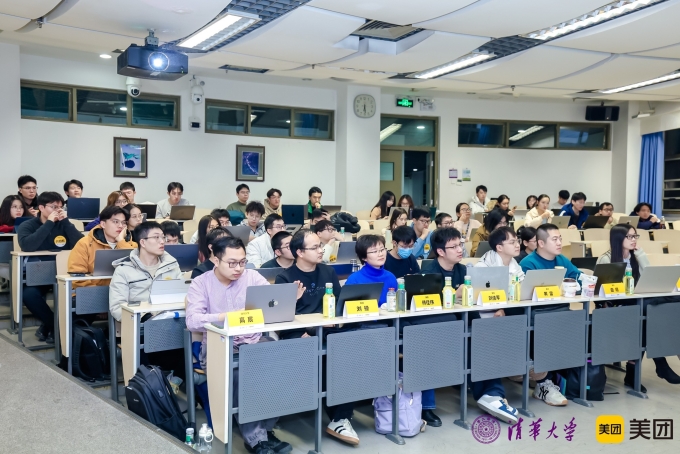
Students during a class at Tsinghua University, October 2025. Photo from Tsinghua University’s Facebook page |
Tsinghua’s Department of Computer Science and Technology has consistently published high-quality papers in leading international journals and conferences. Their research in computer systems has been featured in prestigious venues such as the Principles and Practice of Parallel Programming (PPoPP), the European Conference on Computer Systems (EuroSys), the International Conference for High-Performance Computing, Networking, Storage, and Analysis (SC), the International Conference on Parallel Architectures and Compilation Techniques (PACT), Object-Oriented Programming, Systems, Languages, and Applications (OOPSLA), High-Performance Distributed Computing (HPDC), and the International Conference on Supercomputing (ICS).
Similarly, their work in computer networks has been published in top journals and conferences such as the ACM Special Interest Group on Data Communication (ACM SIGCOMM), IEEE Conference on Computer Communications (IEEE INFOCOM), IEEE Internet Computing, and the ACM/IEEE Transactions on Networking.
link