Cultural barriers to interdisciplinary research collaboration: evidence from Australia
Operationalizing the concept of interdisciplinarity for empirical research is a challenging task (Newman 2024b). A widely-cited report by the US National Academies defines interdisciplinarity as “research by teams or individuals that integrates information, data, techniques, tools, perspectives, concepts, and/or theories from two or more disciplines or bodies of specialized knowledge” (Institute of Medicine 2005: 26), but many authors find this definition to be incomplete, and further attempts at pinning the concept down continue to be undertaken (e.g. Aboelela et al. 2007; Klein 2017). Many studies describe three different levels of interdisciplinary activity, ranging from “multidisciplinarity”, in which knowledge from different research disciplines is used in parallel, to “interdisciplinarity”, in which some boundaries are crossed but where the original disciplines are still apparent, to “transdisciplinarity”, where disciplines are blended to create new fields of knowledge, such as astrobiology or sustainability science (Austin et al. 2008; Gibson et al. 2019). However, these terms are highly subjective and sometimes confusing: for example “transdisciplinary” is often used in a completely different sense, to mean research that is co-produced with end users (e.g. Frodeman 2011). Furthermore, the important distinction between interdisciplinary research, which can be produced by single researchers working across disciplines, and interdisciplinary collaboration, where researchers from multiple disciplines collaborate (but do not necessarily produce interdisciplinary research), is often ignored (Newman 2024b).
In light of these challenges, this study took a pragmatic approach to operationalization. The purpose here is to investigate cultural barriers to interdisciplinary collaboration, that is, collaboration between researchers with backgrounds in different research disciplines. In order to minimize the conceptual work needed for respondents to complete a survey on this topic, a very basic definition was offered: interdisciplinary collaboration was defined, in the survey and in interviews, as working on a research project with partners who are affiliated with a different research discipline than one’s own primary affiliation. All references here to “interdisciplinary research” and “interdisciplinary collaboration” should be understood in this context.
There is a widespread set of beliefs that cultural differences between research disciplines create obstacles to interdisciplinary research collaboration (Brister 2016). The most prominent of these beliefs is that researchers from different disciplines speak in unique “languages”, using terminology or jargon that is unintelligible to outsiders (McCoy and Gardner 2012: 46), and that researchers must learn to speak one another’s language if they want to collaborate (Klein 2014). Accordingly, a great many authors argue that communication between researchers with different research backgrounds is inherently difficult, and that this communication barrier hinders interdisciplinary collaboration (Austin et al. 2008: 562–563; Fraser and Schalley 2009; Szostak 2014; Winowiecki et al. 2011: 75).
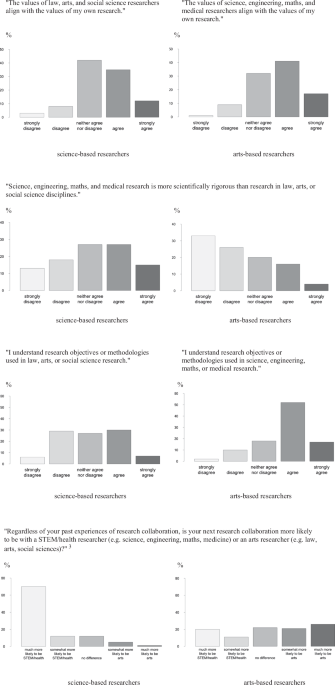
Other cultural barriers to interdisciplinary collaboration have also been noted. Numerous authors, for instance, claim that disciplines use particular methodologies or epistemologies, and therefore interdisciplinary collaborators may not be familiar with the tools of the trade used by their counterparts (Gardner 2013; Lach 2014; Pedersen 2016: 4). Similarly, disciplines have been ascribed their own sets of values, which can produce diverging research objectives and analyses (Robinson et al. 2016), such as when the values of conservation biologists, who want to protect biodiversity, might conflict with those of social scientists, who might instead prioritize the needs of local human communities (Brister 2016). Values divergence at this level would make interdisciplinary collaboration extremely challenging.
If research disciplines have their own unique languages, tools, and values, it is reasonable to expect that members of particular disciplines might engage in some form of tribalism. At the more benign end of the spectrum, disciplinary tribalism might simply be a sense of identity or belonging in a community of like-minded colleagues with common research interests (Lattuca 2001: 36). However, disciplinary tribalism might also produce negative effects, especially if it results in a bias toward a particular way of thinking or an unwillingness to explore research questions, methodologies, or results that contradict an established canon (Robinson et al. 2016). At the far end of the spectrum, tribalism could become a form of protectionism; discipline members might feel threatened by other disciplines, and they might engage in protectionist activities, guarding job markets, research funding, and PhD student placements against encroachment from perceived outsiders (Jacobs and Frickel 2009: 55).
The most widely reported form of disciplinary tribalism is the alleged cleavage between science and the arts. At least since C. P. Snow (1959) famously wrote about the “two cultures”, scholars have debated the existence and significance of this divide (e.g. Andreasen and Ramchandran 2012; Darbyshire 1999; Haste 2016; Leavis 1962; Massey 2019). One major source of contention in this debate is the vague but historically pervasive suggestion that the “hard” sciences (Gardner 2013)—physics, chemistry, biology, mathematics, medicine, and engineering—are more rigorous, and perhaps therefore more legitimate, than other disciplines (Brown et al. 2015; Goldbard 2015; Sorell 1991). If the perception that some classes of research are more rigorous than others currently exists among researchers, this could also present a significant barrier to interdisciplinary collaboration.
Philosophers have tried to define “science” for a very long time, at least since the time of Aristotle (Cohoe 2022). And yet, separating science from art in any definitive way has proven quite difficult. Weber described science as a search for facts that progresses over time (in that new facts emerge that disprove earlier facts), as opposed to arts, in which the product of one era cannot be said to be superior to the product of another (Weber 2013 [1917]: 137–140). However, Weber, a sociologist, made no distinction in his formulations of science between science that relates to the natural world (e.g. physics) and the sciences of human society (e.g. economics), the latter of which we might now assign to the arts (Weber 2013 [1917]; OECD 2015: 56).
In his essay on the two cultures, Snow referred to “humanists” and “scientists” but did not offer a precise definition of either (Snow 1959). More recent writers distinguish between “science and technology” on the one hand, and “humanities, arts and social sciences” on the other (e.g. Massey 2019). The Frascati Manual, a gold standard guide for classifying research and development, separates “the natural sciences and engineering” from “the social sciences, humanities and the arts” (OECD 2015: 54–55). However, again, precision is often lacking, and it is not always clear, for instance, why computer science should be joined with the “natural” sciences when it is about as far from natural as is possible, while sociology should be considered an art when it has a long tradition of the use of scientific method (Giddens and Griffiths 2006). The Australian and New Zealand Standard Research Classification, which divides research disciplines into specific categories for the purposes of funding allocation (e.g. 37 Earth Sciences, 45 Indigenous Studies), has been since 2020 organized in alphabetical order and makes no distinction between science and arts (ABS 2020).
And yet, divisions between research areas that are perceived to be “science” and those that are deemed to be “arts” are manifest. Monash University has a Faculty of Science, which includes biology, chemistry, and physics, and a separate Faculty of Arts that houses history, languages, and social sciences like criminology. Many Australian and international universities are organized similarly: Oxford, for instance, is divided into Medical Sciences, Mathematical, Physical and Life Sciences, Humanities, and Social Sciences; Princeton University is divided into Engineering, Natural Sciences, Humanities, and Social Sciences; McGill University has a Faculty of Arts that includes Art History, Economics, Linguistics, and Political Science, and a separate Faculty of Science that includes Biology, Chemistry, and Physics; the National University of Singapore has a Faculty of Arts and Social Sciences and a separate Faculty of Science. Even those universities where disciplines such as chemistry and political science are grouped in a single faculty (e.g. Yale University) use titles such as the “Faculty of Arts and Sciences”, which further reinforce the distinction. In other words, even without precise definitions, it may be that divisions between arts and sciences are somewhat intuitive.
This lack of definitional precision presents a dilemma for empirical research. Numerous authors (for example, those cited above) describe tension between arts and science disciplines, but no widely accepted definition of either side of this rift is on offer. Rather than attempt to settle a longstanding debate, here I will follow convention in delineating between research disciplines that are widely perceived as belonging to “science” (medicine/nursing/health sciences, natural science/maths/information technology, and engineering) and those that are often referred to as the “arts” (business or commerce, social sciences, humanities, education, creative arts, design or architecture, and law). While this may seem unsatisfactory to those looking for more precise definitions, it is the most practical way to address the research question.
Despite much reasoned debate, empirical data on cultural divisions between science and arts are scarce. Studies have examined differences in how science students and arts students think, but results have been contradictory, with some studies showing a difference (e.g. Lake et al. 2015) while others have reported no difference (Andreasen and Ramchandran 2012; Williamson 2013). Some authors have argued that interdisciplinary research collaboration is on the rise, but even these observers note that “interdisciplinary” in these cases tends to refer to disciplines that are closer together than most science-based research is from arts-based research (e.g. Porter 2009; Rafols et al. 2010). Much has been written about arts disciplines’ adoption of scientific principles to make arts research appear more rigorous, in what has been pejoratively called “scientism” (Sorell 1991)—but again, there is little empirical data on how these attitudes affect or contribute to cultural divisions in research.
Even less is known about how cultural barriers in general, including divisions between arts and science disciplines, might impede interdisciplinary research collaboration (Newman 2024b). In one smaller study of European interdisciplinary researchers, a majority of survey respondents felt that “scientists and artists belong to two different cultures” and “scientists and artists lack mutual understanding” (Vicente and Lucas 2022), but another survey-based study of researchers at dedicated interdisciplinary research institutes at three universities in the United States found “substantial long-distance interdisciplinary collaboration across the natural sciences and social sciences/humanities boundaries” (Bolger 2021). Andersen et al. (2023: 325–326) discuss some perceived barriers to interdisciplinary research but they are mainly material rather than cultural (e.g. lack of funding for interdisciplinary research, fewer jobs available for interdisciplinary researchers). While the idea that arts research and science research are culturally distinct persists (Dirks 2022), more empirical evidence would be required to substantiate these claims.
link