The impact of collaboration networks constructed through common project experience on research output
Tie strength
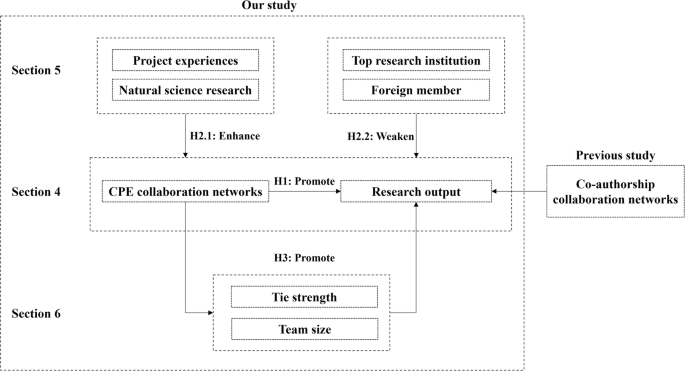
Within the network, nodes form both strong and weak ties. Nodes with strong ties exhibit higher interaction frequency and engage in more profound collaborations. Additionally, strong ties foster trust and reciprocity, which mitigate the risks and costs associated with new collaborations, thereby facilitating the exchange and interaction of knowledge (Liu et al., 2023). On the other hand, weak ties offer greater collaboration diversification, serving as bridges that connect diverse groups within the network and foster the integration of different fields (Lyu et al., 2019). While weak ties may facilitate the cross-pollination of ideas across fields, they encounter challenges during actual implementation. Scientific research demands a high knowledge density and requires frequent discussions and communication during collaborations. Therefore, strong ties play a crucial role and significantly contribute to the development of subsequent projects. To investigate the impact of tie strength on research output within collaboration networks, we computed the tie strength of PI p in year t. Specifically, we determine the tie strength by dividing the number of collaborations the PI engages in with others in the year by the total number of individuals the PI collaborates with. A higher ratio indicates a stronger relationship between the PI and others. We introduced the following model to test the mediating effect of tie strength as a mediating variable.
$${{\rm{TieStrength}}}_{{\rm{p}},{\rm{t}}}={\rm{\alpha }}+{{\rm{\beta }}}_{1}{{\rm{Cen}}}_{{\rm{p}},{\rm{t}}}+{{\rm{\beta }}}_{2}{{\rm{Tit}}}_{{\rm{p}},{\rm{t}}}+{{\rm{\beta }}}_{3}{{\rm{Fund}}}_{{\rm{i}},{\rm{t}}}+{{\rm{\beta }}}_{4}{{\rm{Time}}}_{{\rm{i}},{\rm{t}}}+{{\rm{\beta }}}_{5}{{\rm{WHum}}}_{{\rm{i}},{\rm{t}}}+{\rm{fixed\; effects}}+{{\rm{\varepsilon }}}_{{\rm{i}},{\rm{t}}}$$
(7)
$${{\rm{Y}}}_{{\rm{i}},{\rm{t}}}={\rm{\alpha }}+{{\rm{\beta }}}_{1}{{\rm{Cen}}}_{{\rm{p}},{\rm{t}}}+{{\rm{\beta }}}_{2}{{\rm{TieStrength}}}_{{\rm{p}},{\rm{t}}}+{{\rm{\beta }}}_{3}{{\rm{Tit}}}_{{\rm{p}},{\rm{t}}}+{{\rm{\beta }}}_{4}{{\rm{Fund}}}_{{\rm{i}},{\rm{t}}}+{{\rm{\beta }}}_{5}{{\rm{Time}}}_{{\rm{i}},{\rm{t}}}+{{\rm{\beta }}}_{6}{{\rm{WHum}}}_{{\rm{i}},{\rm{t}}}+{\rm{fixed\; effects}}+{{\rm{\varepsilon }}}_{{\rm{i}},{\rm{t}}}$$
(8)
The results in Table 9 indicate that PI centrality influences the number of project papers and project output efficiency through tie strength. In column 1, the coefficient of Cen is significantly positive, suggesting that PI centrality has a significant positive effect on tie strength. In columns 2–4, TieStrength is added as an independent variable. The coefficients of PI centrality remain significantly positive but are reduced compared to the baseline regression results in Table 2. However, the coefficient of TieStrength is significantly positive only in columns 2 and 4, and only these columns pass the Sobel test, indicating that tie strength mediates the relationship between PI centrality and the number of project papers and project output efficiency. However, it does not mediate the relationship between PI centrality and the citations of project papers, which could be because citations rely more on factors such as the paper’s innovation, cutting-edge research, and the attention drawn to the research topic, which may not be directly related to tie strength.
We hypothesized that the effect of tie strength on the relationship between PI centrality and project output varies significantly with team size. In large teams, PIs with high tie strength and centrality often take on more communication and coordination tasks, leading other members to become overly dependent on the leader. This dependence can stifle the independence and innovation of team members, ultimately reducing the team’s overall innovation capacity. Additionally, PIs with high tie strength and centrality typically serve as information hubs in larger teams. They are more susceptible to information overload, which can heighten the risk of conflicts during decision-making, exacerbate differences in opinion, and create communication barriers. These factors collectively lead to research output falling short of expectations. To test this inference, we divided the sample into larger and smaller groups based on team size and introduced an empirical model with an interaction term between centrality and tie strength to conduct group testing. When the size of the project team exceeds the annual median, it is classified into the larger team group. Otherwise, it is categorized into the smaller team group.
$$\begin{array}{ll}{{\rm{Y}}}_{{\rm{i}},{\rm{t}}}={\rm{\alpha }}+{{\rm{\beta }}}_{1}{{\rm{Cen}}}_{{\rm{p}},{\rm{t}}}+{{\rm{\beta }}}_{2}{{\rm{TieStrength}}}_{{\rm{p}},{\rm{t}}}+{{\rm{\beta }}}_{3}{{\rm{Cen}}}_{{\rm{p}},{\rm{t}}}\ast {{\rm{TieStrength}}}_{{\rm{p}},{\rm{t}}}\\\qquad+{{\rm{\beta }}}_{4}{{\rm{Tit}}}_{{\rm{p}},{\rm{t}}}+{{\rm{\beta }}}_{5}{{\rm{Fund}}}_{{\rm{i}},{\rm{t}}}+{{\rm{\beta }}}_{6}{{\rm{Time}}}_{{\rm{i}},{\rm{t}}}+{{\rm{\beta }}}_{7}{{\rm{WHum}}}_{{\rm{i}},{\rm{t}}}\\\qquad+{\rm{fixed}}\; {\rm{effects}}+{{\rm{\varepsilon }}}_{{\rm{i}},{\rm{t}}}\end{array}$$
(9)
The results in Table 10 show that when team size is large, the interaction between PI tie strength and PI centrality negatively impacts research output, consistent with our inference. In column 1, the interaction term (Cen*TieStrength) coefficient is significantly negative, while it is not significant in column 2. The p value of the coefficient difference test between groups is 0.010, indicating that the coefficient difference is significant. Therefore, columns 1 and 2 suggest that when team size is large, higher tie strength interacting with centrality may negatively affect the number of project papers. The coefficient of the interaction term in column 3 is significantly negative at the 10% level, whereas it is not significant in column 4. The p value of the coefficient difference test between groups is 0.080, indicating that the coefficient difference is significant. Thus, columns 3 and 4 indicate that when team size is large, higher tie strength interacting with centrality may have a negative impact on the citations of project papers. In column 5, the coefficient of the interaction term is significantly negative, while it is not significant in column 6. The p value of the coefficient difference test between groups is 0.000, confirming that the coefficient difference is significant. Therefore, columns 5 and 6 demonstrate that higher tie strength and centrality may negatively affect project output efficiency when team size is large.
Team size
The collaboration network is closely tied to the size of the project team. In general, researchers with higher centrality have greater access to collaborations, increasing the likelihood of selecting suitable partners (Yuan & Van Knippenberg, 2022). Increasing team size can further alleviate individual workloads and expedite research output. Additionally, the continuous inclusion of new members can enhance the diversity of team members’ backgrounds, thereby facilitating the exploration of new research directions. However, the increase in team size also brings disadvantages, including increased management complexity and the potential for exacerbated free-riding behavior among some members. Nevertheless, scientific research teams typically have a relatively flat organizational structure, and the associated increase in management complexity resulting from an expanded team size is relatively minimal. Furthermore, once an article is published, it becomes a lifelong accomplishment for the researcher. Due to reputational considerations, most researchers handle instances of free-riding behavior by others with care. To investigate the impact of collaboration networks on research output through team size, we consider the number of project members as the dependent variable. It should be noted here that the issue of reverse causality between PI centrality and team size is relatively minor. On the one hand, when PIs can engage in multiple projects within the same year, their network centrality is less influenced by team size. On the other hand, when constructing the collaboration network for each year, we incorporate not only each PI’s project experience from the current year but also their experience from previous years, which further mitigates the impact of team size on the collaboration network. We introduced the following model to test the mediating effect of team size as a mediating variable.
$${{\rm{WHum}}}_{{\rm{i}},{\rm{t}}}={\rm{\alpha }}+{{\rm{\beta }}}_{1}{{\rm{Cen}}}_{{\rm{p}},{\rm{t}}}+{{\rm{\beta }}}_{2}{{\rm{Tit}}}_{{\rm{p}},{\rm{t}}}+{{\rm{\beta }}}_{3}{{\rm{Fund}}}_{{\rm{i}},{\rm{t}}}+{{\rm{\beta }}}_{4}{{\rm{Time}}}_{{\rm{i}},{\rm{t}}}+{\rm{fixed\; effects}}+{{\rm{\varepsilon }}}_{{\rm{i}},{\rm{t}}}$$
(10)
$${{\rm{Y}}}_{{\rm{i}},{\rm{t}}}={\rm{\alpha }}+{{\rm{\beta }}}_{1}{{\rm{Cen}}}_{{\rm{p}},{\rm{t}}}+{{\rm{\beta }}}_{2}{{\rm{WHum}}}_{{\rm{i}},{\rm{t}}}+{{\rm{\beta }}}_{3}{{\rm{Tit}}}_{{\rm{p}},{\rm{t}}}+{{\rm{\beta }}}_{4}{{\rm{Fund}}}_{{\rm{i}},{\rm{t}}}+{{\rm{\beta }}}_{5}{{\rm{Time}}}_{{\rm{i}},{\rm{t}}}+{\rm{fixed\; effects}}+{{\rm{\varepsilon }}}_{{\rm{i}},{\rm{t}}}$$
(11)
The results in Table 11 demonstrate that PI centrality influences research output through team size. The coefficient of Cen in column 1 is significantly positive at the 1% level, indicating that as PI centrality increases, team size also increases. When team size is added to the model as an independent variable, the coefficients of Cen in columns 2–4 remain significantly positive. However, compared to the centrality coefficients in Table 2, they are reduced. Additionally, the coefficients of WHum in columns 2–4 are all significantly positive, and each passes the Sobel test. These results indicate that team size mediates the relationship between PI centrality and the number of project papers, citations, and project output efficiency.
We propose the hypothesis that the impact of PI centrality on research output changes nonlinearly as team size expands. When the team size is small, increasing the team size weakens the impact of PI centrality on research output. This is because, with a smaller team, the PI can easily manage the team’s overall dynamics, coordinate tasks, and foster innovation. However, as the team expands, the complexity of communication and management increases, making it difficult for the PI to effectively oversee all members, which diminishes the utility of PI centrality. Once the team reaches a certain critical size, structural and managerial changes may occur. For instance, the team might be reorganized into smaller sub-teams with clearer task allocation and role division. This allows the PI to focus on key decisions while delegating the management of routine tasks. In this scenario, the hierarchical structure enhances management and innovation, leading to a recovery, or even an increase, in the utility of PI centrality as the team continues to grow. To verify this hypothesis, we construct the following model.
$${{\rm{Y}}}_{{\rm{i}},{\rm{t}}}={\rm{\alpha }}+{{\rm{\beta }}}_{1}{{\rm{Cen}}}_{{\rm{p}},{\rm{t}}}+{{\rm{\beta }}}_{2}{{\rm{WHum}}}_{{\rm{i}},{\rm{t}}}+{{\rm{\beta }}}_{3}{{\rm{Cen}}}_{{\rm{p}},{\rm{t}}}\ast {{\rm{WHum}}}_{{\rm{i}},{\rm{t}}}+{{\rm{\beta }}}_{4}{{\rm{WHumSqu}}}_{{\rm{i}},{\rm{t}}}+{{\rm{\beta }}}_{5}{{\rm{Cen}}}_{{\rm{p}},{\rm{t}}}\ast {{\rm{WHumSqu}}}_{{\rm{i}},{\rm{t}}}+{{\rm{\beta }}}_{6}{{\rm{Tit}}}_{{\rm{p}},{\rm{t}}}+{{\rm{\beta }}}_{7}{{\rm{Fund}}}_{{\rm{i}},{\rm{t}}}+{{\rm{\beta }}}_{8}{{\rm{Time}}}_{{\rm{i}},{\rm{t}}}+{\rm{fixed}}\; {\rm{effects}}+{{\rm{\varepsilon }}}_{{\rm{i}},{\rm{t}}}$$
(12)
WHumSqu represents the quadratic term of WHum, and the definitions of other variables remain consistent with the baseline model. If the coefficient of β3 is negative and significant, and the coefficient of β5 is positive and significant, then the hypothesis is supported.
The results of Table 12 demonstrate that PI centrality’s effect on the number of project papers and project output efficiency follows a nonlinear pattern as team size expands. In column 1, the coefficient of the interaction term between Cen and WHum is significantly negative, while the coefficient of the interaction term between Cen and WHumSqu is significantly positive. These results support the hypothesis, indicating that when the team size is small, increasing the number of team members weakens the positive effect of PI centrality on the number of project papers. Conversely, as the team size becomes larger, the increase in team members strengthens the positive effect of PI centrality on the number of project papers.
When the team size is small, the negative effect of expanding the team may be due to increased management complexity or member laziness. In terms of management complexity, a larger team requires more communication and coordination, which may slow down information exchange and complicate decision-making. These challenges could ultimately hinder the execution efficiency and responsiveness of the project. Disagreements and conflicts between team members may also occur more frequently and become harder to manage, requiring more time and resources for resolution. On the member laziness side, individual contributions may become less visible as the team grows, weakening members’ sense of responsibility and reducing work enthusiasm and productivity. Additionally, team members may rely more on others, diminishing personal initiative and work efficiency.
In column 2, the coefficient of the interaction term between Cen and WHum is negative but not significant. In contrast, the coefficient of the interaction term between Cen and WHumSqu is significantly positive. These results do not provide strong evidence that team expansion significantly impacts the relationship between PI centrality and project paper citations. In column 3, the coefficient of the interaction term between Cen and WHum is significantly negative, while the coefficient of the interaction term between Cen and WHumSqu is significantly positive. These results suggest that as team size grows, the effect of PI centrality on project output efficiency follows a nonlinear trajectory.
The following strategies can be considered to address the issues of increased management complexity and member laziness that may arise as team size expands: (i) improving communication efficiency is crucial. Clear communication mechanisms and tools should be implemented to ensure the timely transmission and feedback of information. For instance, project management software and regular team meetings, when used effectively, can assist in tracking progress and resolving issues. Team members should be encouraged to share knowledge and information actively. Internal training sessions or workshops can also be organized to enhance communication skills and overall team efficiency. (ii) Optimizing the decision-making process is essential. Decision-making responsibilities should be streamlined by reducing unnecessary approval steps and enhancing decision-making efficiency. For example, creating a decision-making group or assigning a representative responsible for decisions can contribute to reducing hierarchical complexity. A transparent decision-making process, in which team members understand the rationale and basis for decisions, will likely to foster trust and support within the team.
(iii) Minimizing team conflicts is crucial. A clear conflict resolution process should be established, and training should be provided to enhance team members’ conflict management skills. Conflicts should be addressed promptly to prevent negative impacts on teamwork. When conducted consistently, regular team-building activities and periodic feedback sessions can strengthen collaboration, increase trust among members, and reduce potential friction. (iv) Enhancing team responsibility is essential. Each team member’s roles and responsibilities should be clearly defined to ensure that the importance of their contributions is understood. Such clarity fosters a sense of personal accountability and encourages active participation. Additionally, effective incentives, including performance evaluations and reward systems, should be implemented to motivate team members to maintain enthusiasm and commitment to their tasks.
Different language output
The impact of CPE collaboration networks on research output may vary depending on the language type of the output. The articles funded by the NSFC project are predominantly in English and Chinese. To foster academic exchanges with foreign countries, research institutions often prioritize and incentivize the publication of English articles through bonuses and promotion assessments (Xu, 2020). This phenomenon may motivate researchers to increase their publication of English articles after acquiring resources through collaboration networks. Additionally, English articles have a broader readership, potentially resulting in higher citation rates. Moreover, Chinese researchers face challenges in publishing Chinese articles due to academic inbreeding, as it can be difficult to publish articles without connections to journal editors or other influential individuals. However, the situation is different for Chinese researchers when publishing English articles. On the one hand, they have access to a wider range of English journals. On the other hand, the competition for publication is more equitable since individuals have fewer connections with foreign journals. In conclusion, the influence of collaboration networks on English research output is expected to be more pronounced. We have comprehensively analyzed why PI centrality’s effect on project output is stronger for English papers. This analysis is structured around two key dimensions: research quality and innovation and research influence.
English journals often have stricter editorial and review processes, higher language standards, and more rigorous evaluation criteria, which can result in superior quality and innovation in English papers. The publication of such high-quality or innovative English articles enables researchers to establish broader international collaboration networks, enrich their research perspectives, and gain easier access to global research resources, ultimately enhancing their research output. We analyzed the number of SCI and SSCI papers published within each project to test this inference. These two databases include prominent journals worldwide, predominantly English-language publications. Based on whether the number of SCI and SSCI papers published by a project exceeds the median for all projects in a given year, we categorized the sample into two groups: one with higher quality and innovation and the other with lower quality and innovation.
The results of Table 13 demonstrate that PI centrality has a stronger positive impact on project research output in the group with higher quality and innovation, suggesting that English publications enhance the positive effect of PI centrality on research output through higher quality and stronger innovation. Columns 1 and 2 present the effects of PI centrality on the number of project papers grouped by quality and innovation. The coefficients of Cen are significantly positive across both groups, consistent with the primary findings of this study. However, the coefficient of Cen in Column 1 is larger than in Column 2, with a p value of 0.030 for the inter-group coefficient difference test, indicating that PI centrality has a stronger positive effect on the number of project papers in projects with more high-quality and innovative English articles. Columns 3 and 4 report the grouped regression results on the effect of PI centrality on the citations of project papers. The coefficient of Cen in Column 3 is greater than in Column 4, and the p value of the inter-group coefficient difference test is 0.000. These results indicate that PI centrality has a stronger positive effect on the citations of project papers in projects containing more high-quality and innovative English articles. Finally, Columns 5 and 6 show that the positive impact of PI centrality on project output efficiency is also stronger in projects with more high-quality and innovative English publications.
As the dominant language in international academic exchanges, English offers several advantages over other languages, such as greater international visibility, stronger academic influence, enhanced resource integration, and a more pronounced reputational effect for its publications. When PI centrality is high, the collaboration network of the PI can better capitalize on these advantages, thereby amplifying the influence of English papers. These enhanced opportunities for dissemination and higher citation rates strengthen the role of centrality in driving project output. To verify this inference, we calculated the average number of English and Chinese papers per project, which were 11.381 and 8.677, respectively, indicating that NSFC projects clearly prefer publishing in English. Then, the average citations per project were examined. English papers received an average of 290.711 citations compared to 101.806 for Chinese papers, demonstrating that English publications garner more citations and thus contribute more to personal academic influence.
Finally, we utilized the output language structure of a project to measure the influence of English output. The output language structure is measured by the proportion of English output of a project, calculated as the ratio of the average citations of the project’s English papers to the average citations of its Chinese papers. If a project’s proportion of English output exceeds the annual median, it is classified as having a high proportion of English output; otherwise, it is classified as having a low proportion of English output.
The results in Table 14 show that the positive impact of PI centrality on project output is stronger when the proportion of English output in the project is higher. Columns 1 and 2 present the group test results for the impact of PI centrality on the number of project papers. The coefficient of centrality (Cen) is significantly positive in both groups, consistent with the basic regression results of this study. From an economic perspective, the coefficient for the group with a higher proportion of English output is greater than that for the group with a lower proportion. The inter-group coefficient difference test shows that the p value for the difference in Cen between columns 1 and 2 is 0.080, which is significant at the 10% level. Thus, the impact of centrality on the number of project papers is stronger in the group with a higher proportion of English output. English-language outputs have greater dissemination potential and more citation opportunities. By leveraging this advantage, PIs can further enhance their influence within the collaboration network, consolidate more resources, and increase the number of project papers.
Columns 3 and 4 report the group test results for the impact of PI centrality on the citations of project papers. The Cen coefficient in column 3 is greater than in column 4, and the p value for the inter-group coefficient difference test is 0.000, indicating that the positive impact of centrality on project paper citations is also stronger when the proportion of English output is higher. Columns 5 and 6 present the group test results for the impact of PI centrality on project output efficiency. As expected, the impact of PI centrality on output efficiency is stronger when the proportion of English output in the project is higher. The greater impact of English-language output can provide PIs with more collaboration opportunities, enhance their influence within the collaboration network, and subsequently increase both citations and the efficiency of project output.
link